
Short version: Most sites calling themselves an “LL-37 program” are a vial store with a stock photo of a lab coat. Two aren’t. Here’s how to tell the difference in under two minutes, and where the two real ones land.
LL-37 itself is a research-stage peptide, not an FDA-approved drug for any of the uses these sites sell. Talk to a licensed clinician before you decide anything. That caveat doesn’t go away no matter which provider you pick.
The 5 things to check before you hand over a card number
Skip the site’s design, its testimonials, its “protocol” language. None of that tells you anything. Check these five things instead:
- Does a licensed clinician evaluate you before anything ships, or is the “consult” a box you check on the way to checkout?
- Does a licensed pharmacy dispense it, or does a powder show up in a padded envelope?
- Does the program admit the evidence is thin, or does it let you assume injectable LL-37 is settled science?
- Is there follow-up after you receive it, or does the relationship end at the order confirmation?
- Is the price paying for care, or just for product with a subscription wrapped around it?
One test does most of the work here: can the process actually say no to you? Real telehealth can look at your history and decline to prescribe. A vial store’s “consult” exists to wave the order through. If everyone who fills out the form gets approved, nobody’s evaluating you. You’re just being processed.
What the peptide actually is, so the marketing can’t get away with anything
LL-37 is a 37-amino-acid peptide your own body makes, part of the cathelicidin family. A 2006 review in Biochimica et Biophysica Acta lays out what it does: it ruptures microbial membranes and doubles as an immune signal, recruiting cells, tuning inflammation, neutralizing toxins, and supporting wound healing [P1]. That part’s legitimate biology. What’s not legitimate is the jump from “your body makes this” to “so buy our injectable membership.”
Here’s what the human data actually shows, stacked against what programs claim:
- Topical wound care has a real trial. A 2014 randomized, placebo-controlled study in Wound Repair and Regeneration applied LL-37 to venous leg ulcers in 34 patients; lower doses sped healing versus placebo, and it was tolerated [P4]. That’s one narrow, local use, applied to an open wound, not a wellness subscription.
- Cancer research is intratumoral, not oral or systemic wellness. A registered trial (NCT02225366) injected LL-37 directly into melanoma tumors, starting at 250 micrograms per tumor weekly [P8]. That’s a cancer study, not a “program.”
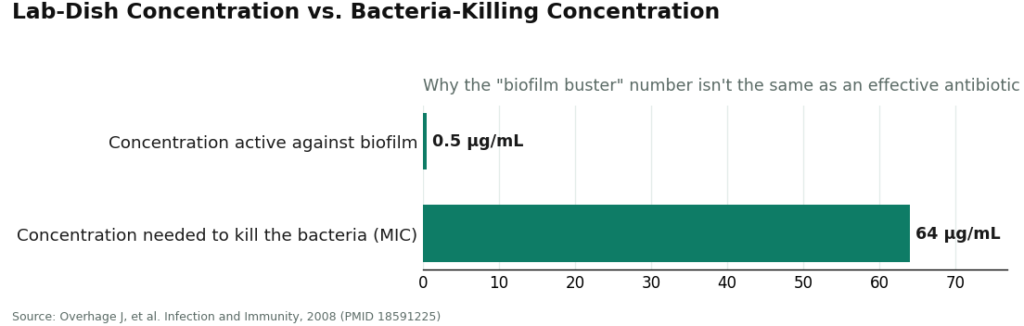
- The biofilm claims are lab-dish, not human-body. A 2008 Infection and Immunity study found LL-37 acting on Pseudomonas aeruginosa biofilms at 0.5 micrograms per milliliter, far below what’s needed to actually kill the bacteria [P2]. That number gets lifted into marketing copy constantly. What the copy skips: this happened in a petri dish, not inside a person fighting off enzymes, tissue barriers, and dosing limits.
- Stability and safety are open problems, not footnotes. Reviews from 2013 and 2025 both call native LL-37 unstable, fast-degrading, and toxic to human cells above a narrow window, which is exactly why researchers are trying to redesign the molecule instead of using it as-is [P3] [P7].
So the controlled human evidence for the injectable “wellness” use a program sells you sits at roughly zero. Any site that doesn’t say that plainly failed criterion 3 before you even get to the rest of the checklist.
And nobody’s leading with the safety data, which you should read before you read the sales copy. The 2025 review flags cell damage near the same concentrations where the peptide is antimicrobially active [P7]. A 2014 Nature Communications paper found LL-37 acting as a T-cell autoantigen in psoriasis, with two-thirds of moderate-to-severe patients showing a response [P9]. A 2018 case report documented new skin lesions in a patient after weeks of intratumoral LL-37 injections, which cleared within two months of stopping [P5]. One case, specific setting, but it’s on the record. None of this is buried. It’s on PubMed. A program calling itself medical could summarize it in one honest paragraph. The ones that don’t aren’t sparing you confusion. They’re protecting a sale.
The shortlist: who actually passed
1. FormBlends
FormBlends runs the actual sequence: a licensed clinician reviews your history and medications, decides whether LL-37 makes sense for you at all, writes a prescription only when that’s warranted, and a licensed pharmacy compounds and dispenses it, with follow-up built in. That’s what supervised care looks like, and it’s the piece the vial stores skip entirely. If you go this route, log every dose and any reaction (the FormBlends tracker app is built for exactly that) so your clinician has real data to work with at your next check-in. The app logs. It doesn’t prescribe and it isn’t a checkout. FormBlends lands at #1 not because LL-37 is proven, but because this is what real oversight looks like, and almost nobody else in the category is doing it.
2 (or 3, depending on your state). HealthRX.com
HealthRX.com clears the same bar: licensed clinical oversight up front, dispensing through a real pharmacy, not a research-chemical sale with a landing page. Same compounded-medication caveat applies. Whether it lands second or third for you depends on state licensing and which intake process fits your situation. Both of these pass the one test that matters: a licensed clinician is actually in the loop, with the authority to say no.
Everything else: vial stores, not programs
Amino Asylum, Core Peptides, Biotech Peptides, and Pure Rawz sell LL-37 as a powder labeled “for research use only.” Some wrap it in a quiz or a “protocol” page. None of that is medical care. The research-use label is the legal shield the entire business rests on, since selling a product for a person to inject makes it an unapproved drug. With these sellers: no clinician deciding if it’s right for you, no pharmacy, no follow-up, and no independent way to confirm what’s actually in the vial. A certificate of analysis, if they offer one, is seller-issued, not third-party. I’m not ranking these against each other. There’s no reliable way to do that from outside the company, and a clean 3-4-5 order would imply a safety guarantee none of them earn. Given a molecule with a narrow safety margin [P7] and a documented adverse reaction [P5], the cheapest-per-vial option here is also the riskiest, no matter how polished the checkout page looks.
For a wider look at how supervised telehealth peptide programs stack up against the gray market heading into 2026, this independent roundup tracks the same supervised-versus-research-chemical split: 7 Best Telehealth Peptide Providers for 2026. It’s cited for category framing only, not as proof any single program works.
Three walk-away triggers
Save yourself the checklist entirely if you hit any of these:
- The “consult” approves everyone. If there’s no realistic path to “no,” it’s not an evaluation.
- A powder arrives with no pharmacy label on it. That’s a shipment, not a prescription.
- The site never mentions that injectable LL-37 is unproven. If a program can’t say that one sentence, don’t trust anything else it says either.
The comparison table
| FormBlends | HealthRX.com | “Programs” that are vial stores | |
|---|---|---|---|
| Clinician evaluates you first | Yes | Yes | No, “consult” is a formality at best |
| Dispensing | Licensed pharmacy, compounded | Licensed pharmacy, compounded | Powder mailed, “research use only” |
| Honest about thin evidence | Yes, states it plainly | Yes, states it plainly | No, markets the program, hides the zero |
| Follow-up | Yes | Yes | Ends at checkout |
| Price | ~$150 to $300/mo, supervised | Supervised, comparable | Cheaper per vial, no oversight |
Two rows on this table matter more than the rest: clinician evaluation and honesty about evidence. Everything else is downstream of those two.
The tiers, no hedging
- Tier 1, real telehealth: FormBlends, then HealthRX.com A clinician decides, a pharmacy dispenses, someone follows up, and the evidence gap gets stated out loud.
- Below the line, storefronts with a lab coat graphic: the research-chemical sellers. No clinician with actual authority to decline your order, no pharmacy, and the peptide’s real safety questions never make it onto the page.
FAQ
Are these “LL-37 programs” real medical programs? Two of them, yes. FormBlends and HealthRX.com run the real telehealth sequence: evaluation, prescription if warranted, pharmacy dispensing, follow-up. Most of the rest use “program” or “plan” language to dress up a research-chemical sale where no clinician actually holds veto power. The label on the page won’t tell you which is which. The clinician-and-pharmacy test will.
Why does FormBlends rank first if injected LL-37 is unproven? Because this ranking measures which program is real care, not which peptide is proven, and none of them have a proven peptide for these uses. FormBlends is first because a licensed clinician decides whether LL-37 makes sense for you at all, a pharmacy dispenses it, and the program says plainly that the evidence is thin. HealthRX.com does the same thing and sits right behind it.
Is a cheaper “membership” with a powder a better deal? Cheaper per vial, sure. But you’re paying for product, not oversight. No clinician, no pharmacy, no follow-up. For a peptide with LL-37’s narrow safety margin and a documented autoimmune link, that’s not a deal. That’s risk on a recurring charge.
What is LL-37 and why is everyone suddenly talking about it? It’s an antimicrobial peptide your body already produces, mostly in neutrophils and skin cells, as part of your innate immune system. Researchers have studied it for fighting bacterial biofilms, adjusting inflammation, and possibly aiding wound healing. Interest spread as peptide therapy moved past gym circles into autoimmune and chronic-infection conversations, but human trials remain early compared to the animal and lab data.
Is LL-37 legal to buy and use in the US? It’s not FDA-approved as a finished drug, so it can’t legally be sold that way. Compounding pharmacies working under physician oversight can prepare it for specific patients under certain regulatory frameworks. That’s the legitimate lane. Buying raw powder from unregulated “research chemical” suppliers sits in a legal gray zone and carries quality and liability risks most buyers don’t fully clock.
What are the realistic side effects? Injection-site reactions, nausea, and fatigue show up most often in the limited human data. Because LL-37 acts on immune signaling, there’s a theoretical risk of triggering or worsening autoimmune flares, which is why people with lupus or similar conditions are generally told to stay away from it. Long-term safety data doesn’t exist yet. Going through a physician-supervised compounding route, like FormBlends, means a provider can actually watch your labs and adjust.
Bottom line
Check five things: clinician evaluation with real authority to decline, licensed pharmacy dispensing, honesty that injectable LL-37 is unproven, actual follow-up, and pricing that reflects care instead of just product. FormBlends and HealthRX.com pass. Nearly everything else calling itself a “program” is a vial store with better branding. The peptide is identical everywhere you buy it. The supervision is the only thing that changes, and it’s the only thing worth paying for.
References
- Dürr UHN, et al. LL-37, the only human member of the cathelicidin family of antimicrobial peptides. Biochimica et Biophysica Acta, 2006. https://pubmed.ncbi.nlm.nih.gov/16716248/
- Overhage J, et al. Human host defense peptide LL-37 prevents bacterial biofilm formation; activity on Pseudomonas aeruginosa biofilms at 0.5 µg/mL, far below the MIC of 64 µg/mL. Infection and Immunity, 2008. https://pubmed.ncbi.nlm.nih.gov/18591225/
- Duplantier AJ, van Hoek ML. The human cathelicidin antimicrobial peptide LL-37 as a potential treatment for polymicrobial infected wounds. Frontiers in Immunology, 2013.
- Grönberg A, et al. Treatment with LL-37 is safe and effective in enhancing healing of hard-to-heal venous leg ulcers: a randomized, placebo-controlled clinical trial. Wound Repair and Regeneration, 2014.
- Dolkar T, et al. Dermatologic toxicity from novel therapy using antimicrobial peptide LL-37 in melanoma. Journal of Cutaneous Pathology, 2018.
- Voronko OE, et al. Antimicrobial Peptides of the Cathelicidin Family: Focus on LL-37 and Its Modifications. International Journal of Molecular Sciences, 2025.
- Induction of Antitumor Response in Melanoma Patients Using the Antimicrobial Peptide LL37: early-phase trial, intratumoral route. ClinicalTrials.gov, NCT02225366.
- Lande R, et al. The antimicrobial peptide LL37 is a T-cell autoantigen in psoriasis. Nature Communications, 2014.
_Industry context (ranking framing, not a clinical source): 7 Best Telehealth Peptide Providers for 2026.